
CBSE or Cambridge IGCSE: Which Board to Choose?
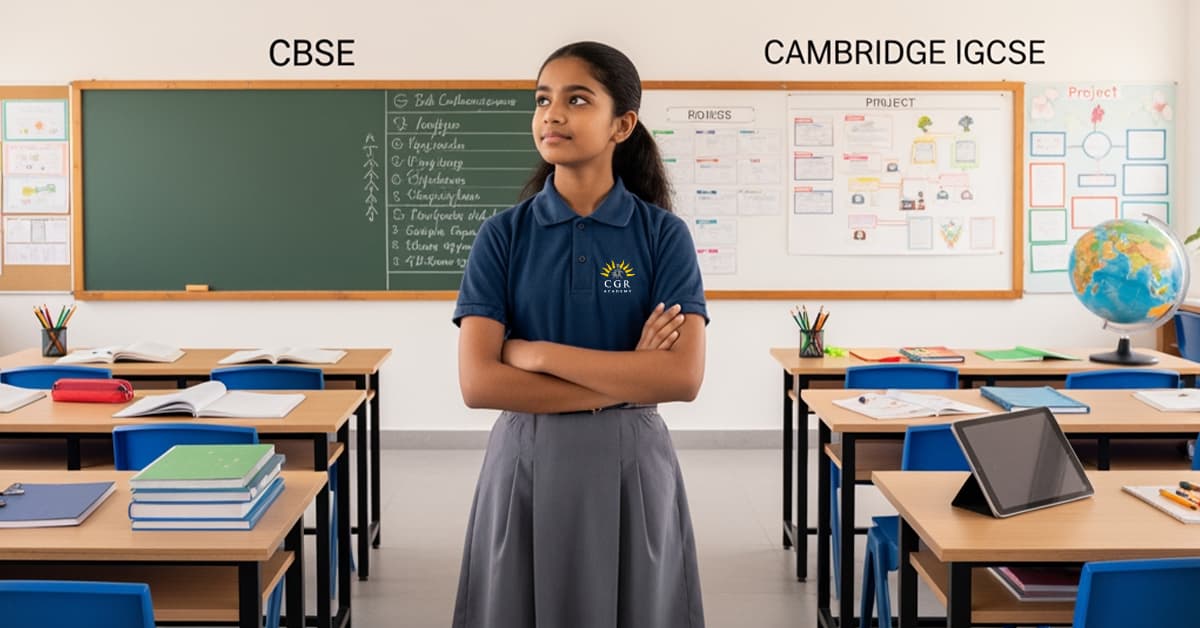
One of the most important choices any parent has to make is school board selection. Today in India, there are a number of choices for parents, with a flood of schools offering more than one curriculum and both national and international boards. With increased emphasis on teaching style, assessment patterns, and global readiness, parents also seem to be contemplating the most fitting academic pathways for their children.
In cities such as Hyderabad, the final decision is very often a toss-up between the CBSE curriculum and the Cambridge IGCSE. One follows a completely different philosophy and model of learning from the other, thus serving very different types of students. The right choice is often a function of the learning style of the child concerned, plans for the future, and the kind of environment parents wish to create for early and middle-school education.
Understanding the CBSE Curriculum
The CBSE curriculum is the most widely embraced educational structure in India. Organised, uniform, and prefigured, it ensures that students move from one class to another in a systematic order. The curriculum strengthens the core of subjects like mathematics, science, languages, and social science. Since CBSE is also aligned with entrance tests of higher education institutions and national education goals, it becomes a familiar proposition for parents.
A strength of CBSE is the organisation of learning in the early and middle-school years. A combination of structure is adopted by many schools, gradually building conceptual understanding. Early childhood learning in CBSE schools more or less aims at building basic foundations in literacy, numeracy, vocabulary, and communication. Progressively, as the child moves up the classes, the level of difficulty of the subject matter increases to ensure that students have truly grasped concepts at every stage before proceeding to the next.
The CBSE system is also well known for its clearly demarcated academic structure, which reduces discrepancies when families relocate. Since CBSE is centralised across the country, transferring students from one school to another becomes much easier. Furthermore, many CBSE schools organise their syllabus with activities that promote project-based learning combined with co-curricular programmes, supporting holistic growth.
Understanding the Cambridge IGCSE Curriculum
The Cambridge IGCSE is an internationally recognised board that embraces an inquiry-based approach to education. The curriculum encourages students to explore topics deeply through research, discussion, and analysis. Learning is promoted based on understanding concepts rather than merely memorising facts, and applying them to real-world situations.
Another distinguishing characteristic of IGCSE is the wide choice of subjects it provides. Students are free to choose subjects that best suit their interests, strengths, or future career plans. Through this flexibility, students are also able to delve deeply into creative subjects, humanities, or science-oriented studies. For those seeking a global standard of education for their children, IGCSE is often considered, as it is accepted by foreign universities.
Assessments under IGCSE are also different from CBSE. Apart from written examinations, IGCSE involves assessment through coursework, project work, written assignments, and oral assessments. This enables students to showcase skills through various learning styles and supports the development of critical thinking, communication, and problem-solving skills.
Key Differences Between CBSE and IGCSE
Even though CBSE and IGCSE provide excellent education, they have different methods of implementation. Hence, these differences play a role when parents select a school board.
CBSE follows a common and well-structured syllabus across all its schools. It guides subjects based on knowledge, clarity, and progressive learning. Most CBSE schools include fun-based activities, hands-on exercises, and teacher-led classroom activities in their study schedules. Children learn through classroom instruction and assignments, followed by multiple evaluations.
In contrast, IGCSE offers students the freedom to choose subjects according to their interests and follows an inquiry-oriented learning approach. Students learn through discussions, projects, and real-world applications. The curriculum provides a wide range of subjects and encourages independent and analytical thinking.
CBSE examinations generally follow a fixed pattern with internal assessments combined with yearly board examinations. IGCSE incorporates multiple assessment tools such as practical application tests, oral tests, and presentations.
In terms of recognition, CBSE is suitable for students preparing for higher education in India and domestic competitive examinations. IGCSE is internationally recognised and accepted by global universities, supporting worldwide academic pathways.
Similarities Between the Two Boards
Despite their differences, both CBSE and IGCSE share several common elements.
Both boards focus on academic and personal development. Schools following either curriculum emphasise early learning, structured education, extracurricular activities, and the development of foundational concepts. Whether CBSE or IGCSE, early schooling includes activity-based learning, language development, and exposure to basic concepts in science and mathematics.
Schools affiliated with both boards generally provide well-planned infrastructure, safe classrooms, and child-friendly environments that allow students to learn and express themselves. These systems aim to develop confidence, communication skills, social behaviour, and practical knowledge.
Which Board Is Suitable for Which Student?
When choosing between CBSE and IGCSE, the primary considerations are the child’s learning behaviour and long-term goals. Children who perform well in structured learning environments with clear schedules and predictable assessments may find the CBSE curriculum more suitable.
On the other hand, children who prefer creative exploration, independent research, or multiple modes of expression may find IGCSE more appropriate. Cambridge IGCSE offers flexibility, allowing students to pursue specialisation or broader subject exposure.
CBSE offers a strong foundation for families planning higher education in India and preparation for competitive examinations, while IGCSE, with its international framework, suits families seeking global exposure or careers abroad.
Academic Structure in Schools That Offer CBSE or IGCSE
Most schools offering CBSE or IGCSE follow a systematic academic structure, especially in the early years. Some adopt blended models where students learn through experiments, classroom discussions, and hands-on activities during foundational stages. Early education includes Nursery and Primary grades, gradually progressing toward more structured subject learning in middle school.
Facilities are designed to be safe and age-appropriate, including laboratories, libraries, and open spaces that enhance learning beyond theoretical instruction. This approach is common across CBSE and IGCSE schools in Hyderabad, where modern infrastructure plays a significant role in the overall learning experience.
What Parents Should Consider Before Choosing a Board
Parents should evaluate several factors before deciding whether CBSE or IGCSE is more suitable:
- The learning pace that suits the child
- Exposure to different subjects
- Future educational plans
- Assessment patterns
- Academic support available at the school
- Classroom environment and teacher interaction
The right choice depends on what families prioritise for their child’s academic and personal development.
Why CGR Academy Is a Strong Choice for Both CBSE and Cambridge Pathways
For families exploring both CBSE and Cambridge IGCSE options in Hyderabad, CGR Academy offers an environment that supports modern teaching approaches, structured academics, and a balance between logical reasoning and conceptual understanding.
With age-appropriate early-years education, activity-based learning, and a carefully planned school environment, CGR Academy provides a comprehensive developmental approach that nurtures curiosity and confidence in students as they progress academically. This makes it a suitable choice for families seeking strong academic foundations alongside holistic development within national and international frameworks.
Final Thoughts
There is no absolute choice between the CBSE curriculum and the Cambridge IGCSE, as both offer strong academic programmes with different strengths. CBSE provides standardisation, structure, and nationwide continuity, while IGCSE offers flexibility, subject choice, and an international outlook. When searching for the best CBSE or Cambridge school in Hyderabad, parents should consider their child’s interests, learning abilities, and future aspirations. Understanding how schools implement the curriculum, guide students, and nurture growth is essential. Beyond the board itself, it is the overall learning experience, values, and environment that truly shape a child’s academic and emotional development.