How to Build a Reading Habit in Kids: Activity-Based Ideas from Pre-Primary to Grade 8
Getting a child to read regularly can be surprisingly difficult. The books may be right there, but a phone, a game, or even a favourite cartoon can feel much more interesting. So how to build a reading habit in children without turning every reading session into another task?
The answer may be simpler than it sounds. Reading does not always have to mean sitting quietly with a book for thirty minutes. For younger children especially, it can begin with play, pictures, stories, questions and small everyday activities.
Start With Stories, Not Reading Rules
For a pre-primary child, reading often begins before the child can actually read words. Looking at picture books, guessing what happens next, making up funny endings and acting out a familiar story all count.
A parent might read a short story and then ask, “What do you think the dog will do now?” The child is listening, thinking and connecting ideas. There is no pressure to get the answer right.
This is where the importance of activity based learning becomes quite clear. When reading feels like something a child can do rather than something a child has to do, it is easier to enjoy.
Turn Reading Into A Small Activity
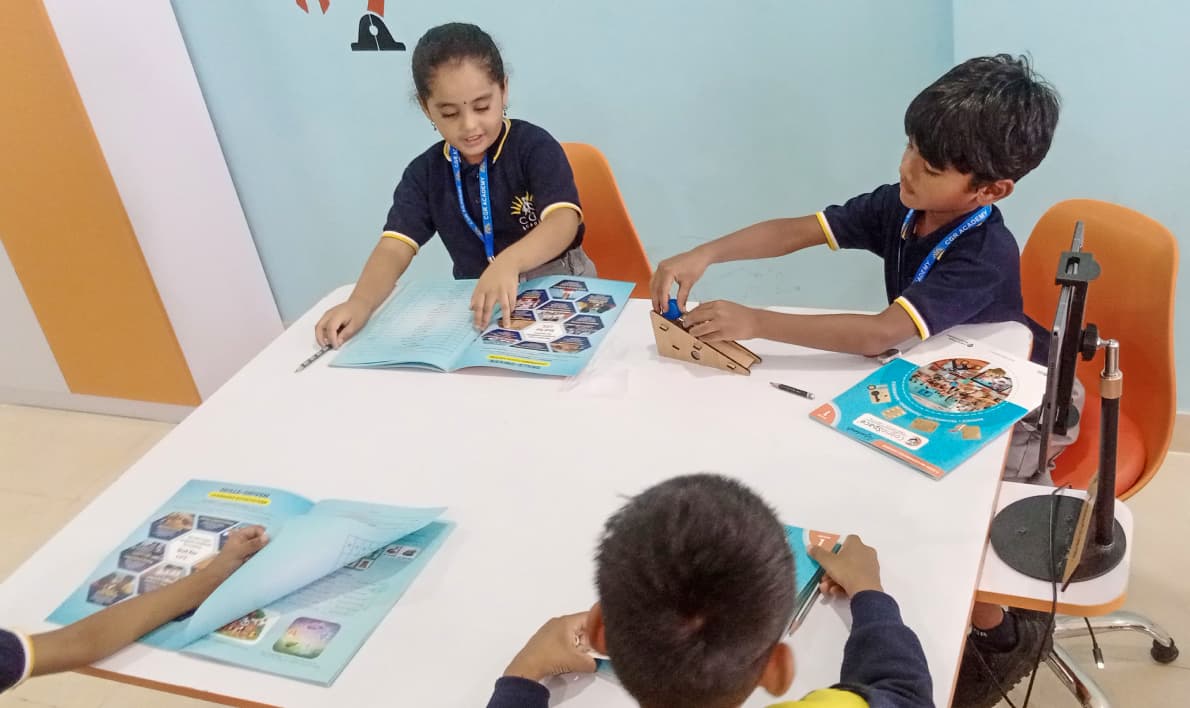
As children move into primary school, reading activities can become a little more interesting. A story can be followed by drawing a favourite character, making a paper puppet, finding five new words or acting out one scene.
A child reading about animals could make a little “animal fact book”. A child reading a mystery story could write down clues before reaching the ending. These small activities give reading a reason beyond finishing a chapter.
They also connect nicely with the benefits of inquiry based learning, because children begin asking questions instead of simply moving from one page to another.
Let Older Children Choose Their Reading
By the time children reach Grades 5 to 8, the problem often changes. They can read, but they may not want to. This is where choice matters.
A child who does not enjoy novels might happily read comics, biographies, sports stories, science magazines, travel writing or books about a favourite hobby. Reading does not become a habit because every book is considered “good”. It becomes a habit when the child finds something worth coming back to.
Parents can also let children abandon a book that clearly is not working for them. Finishing every book is not the point. Finding books they actually want to read is.
Make The Phone Less Interesting, Not Reading More Difficult
The question of how do I get my child to read more instead of using a phone comes up in many homes. Usually, simply taking the phone away does not make a book suddenly fascinating.
A better starting point may be creating a small reading space and a predictable reading time. Ten or fifteen minutes after dinner can be enough. Parents can also keep their own phones aside and read at the same time. Children notice that more than they let on.
Reading together can help too, even with older children. A parent reading a few pages of the same book and talking about it later can make the activity feel shared rather than imposed.
Reading Through Questions And Curiosity
At CGR Academy, we try to keep this spirit of curiosity in everyday learning. With our blended approach combining CBSE structure and Cambridge-inspired teaching practices, children are encouraged to ask “why” and “how”, not simply remember answers. Reading can work in much the same way when children are given space to question, discuss and connect what they read with real life.
The setting matters too. A school does not have to treat reading as something separate from other activities. Projects, technology, science, art and classroom discussions can all give children reasons to read something because they want to find out more.
What Reading Can Look Like At Different Ages- CGR Academy’s Take
For a preschooler, reading might mean listening to a story and arranging picture cards in the right order. In the early primary years, it could mean creating a comic strip from a chapter or searching for interesting words.
By middle school, children can compare two characters, research the real event behind a story or write a different ending. The activity changes as the child grows, but the basic idea stays the same: reading becomes more enjoyable when there is something to do with what has been read.
At CGR Academy, we see this connection between reading, questioning and hands-on learning as an important part of helping children become independent learners. Our classrooms use projects, activities and practical experiences alongside academics, giving students opportunities to look at ideas rather than simply memorise them. For families considering the best pre primary schools in Kollur or the best primary schools in Kollur, this kind of learning environment is worth looking at alongside academics.
Build A Habit That Does Not Feel Forced
A reading habit rarely appears overnight. It may begin with five minutes, one favourite book, a bedtime story or a child asking what happens on the next page. That is enough to start.
The goal is not to make every child a bookworm. It is to help children see books as something they can enjoy, question and return to. When reading is mixed with play in the early years, choice in the primary years and curiosity in the later years, it has a better chance of becoming part of everyday life.
And perhaps that is the simplest way to look at it: how to build a reading habit in children is less about making them read more and more about giving them reasons to want to read.
FAQs
1. How do I find a good school near Kollur ORR?
Look at homes and schools together, and check the real morning route, school timings and traffic instead of just the distance shown online.
2. Which schools can families living in Tellapur consider?
Families in Tellapur can look beyond its boundaries, since a school a short drive away in Kollur or another nearby locality can work just as well if the route is easy.
3. What makes CGR Academy a CBSE and Cambridge school option near Nallagandla and Gopanpally?
CGR Academy combines the CBSE framework with Cambridge-inspired teaching, building on 15 years at CGR International School to help children understand concepts rather than memorise them.
4. Which area of Hyderabad is good for families with school-going children?
Kollur, Tellapur and Velimela in western Hyderabad are all worth a look, and the right choice is the one that gives you a comfortable balance of home, school and daily travel.
5. What facilities does the CGR Academy campus in Kollur have?
The 7-acre campus has 4 acres of outdoor play and learning space, plus science and design-thinking labs, sports facilities, and spaces for music, art and other activities.