
Where Learning Meets Creativity: Inside the CGR Academy Campus
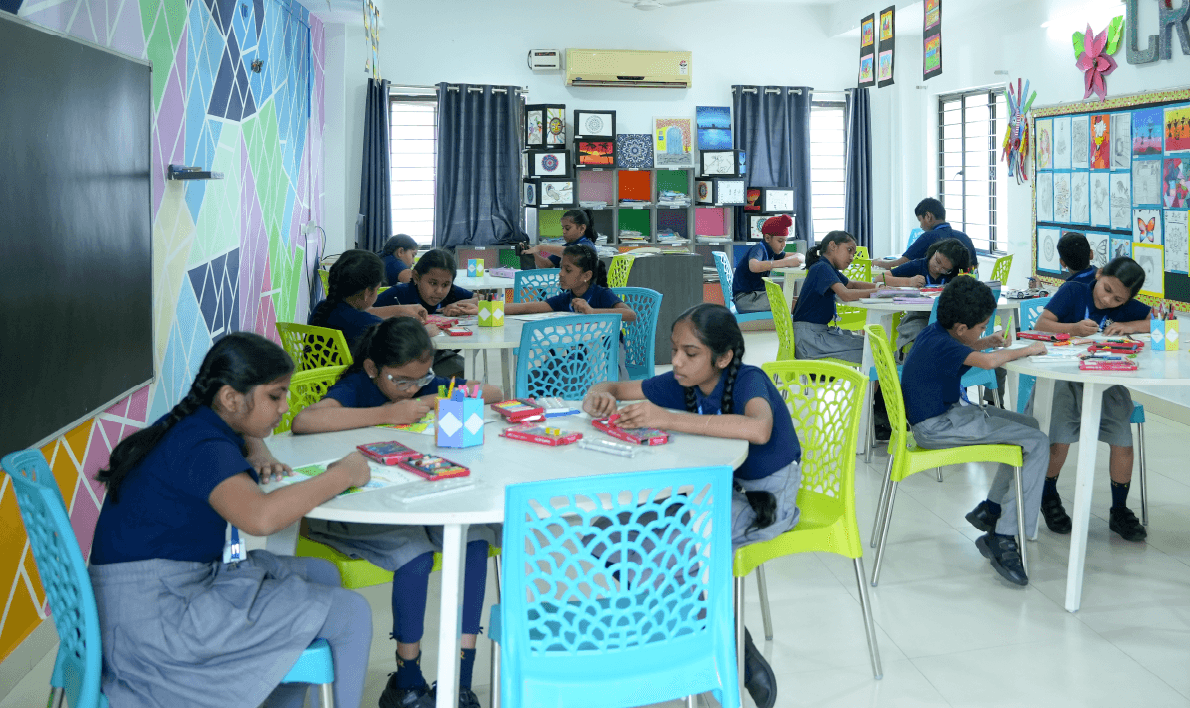
The campus in the school plays many roles other than acting as a classroom for the child to learn in. How the child navigates through the campus throughout the day affects how the child learns, socialises, experiments, develops confidence and enjoys him/herself. In the same way that a lesson plan facilitates learning, the campus helps in developing curiosity in the mind of the child.
At CGR Academy in Kollur, we have built our modern school campus around this idea. Occupying seven acres, out of which four are for outdoor play and sports, our campus incorporates the academic, technological, creative, emotional, and physical aspects of learning. As opposed to treating all of these individually, we have designed a learning environment wherein students are able to transition easily from traditional classroom-based education to areas that stimulate imagination, critical thinking, cooperation, and expression.
A Campus Designed for More Than Classroom Learning
The traditional classroom continues to be relevant, but there is more to it now than just rows of desks and a blackboard at the front of the room. There has to be something in which students can explore concepts, raise questions, collaborate, and relate concepts to real-world situations.
The school infrastructure of our school embodies this broad perception of education. The classroom equipped with technological aids allows for interactive learning. Special laboratories and places designated for activities provide the necessary platform for the application of learned knowledge. It turns our institution into something that is more than just a mere source of information.
For our purposes, we feel that an ideal learning environment should enable students to develop confidence in asking why and how. The curiosity that the learner exhibits should not just stop at the end of the class but should go on to pervade the lab, the playing field, the art room, and even their conversations with other people.
Creative Learning Spaces Give Ideas Somewhere to Grow
Creativity can be expressed in various ways. It could be through music in one student, through painting in another, through theatre for yet another, and through making an effort to solve a problem in another. Enough space must be allowed to the children in school.
Our creative learning spaces include The Music Lab, Art Room, Dance Room, Design Thinking Lab, Imaginarium STEAM Lab, and Little Explorers Room for toddlers. All of these are employed for different purposes, but the common thread running through all of them is active engagement.
For instance, the Design Thinking Lab is a place where students are encouraged to find out about issues, come up with ideas, and test various solutions. The use of STEAM enables the conduct of experiments in multiple areas like science, technology, engineering, arts, and math. Music, arts, and dance provide different opportunities for self-expression and building confidence.
These experiences are not treated as distractions from academics. They are part of how children learn to think independently and apply knowledge creatively.
Technology Should Help Students Explore, Not Simply Consume
Digital tools are now part of everyday life, so schools have an important responsibility to help students use technology thoughtfully rather than passively. The presence of screens alone does not create meaningful technology-enabled education.
At CGR Academy, our ICT Lab and tech-enabled classrooms are designed to support digital readiness and active learning. Across our academic programmes, students are also introduced to areas such as Artificial Intelligence, Robotics, 5G, IoT, and AIoT in age-appropriate ways.
Technology becomes most useful when it helps students investigate, create, analyse, and solve problems. Our approach is therefore to integrate it with projects, discussions, experiments, and other forms of applied learning rather than allowing technology to replace interaction between teachers and students.
The Learning Resource Centre Creates Space for Independent Discovery
Sometimes, children may not necessarily learn effectively if they are constantly being told what to study next. Being independent also requires one to learn how to look for information, pursue their own interests, read, and think.
Our Learning Resource Centre provides an additional forum for exploring other concepts apart from what is directly taught in class. These forums are quiet places for learning compared to others on campus and provide a chance for learners to conduct research and reading.
A well-balanced international school campus or contemporary CBSE campus should support different styles of learning. Some moments require collaboration and conversation, while others require focus and reflection. Providing both helps students discover how they learn most effectively.
Social and Emotional Learning Has Its Own Space
Academic ability is just one component of a child’s development. Children must learn about emotions, how to communicate well, cooperate with others, deal with situations, and believe in themselves.
Our SEL lab reflects our approach, in which we emphasise developing emotional intelligence along with the intellectual side. Through the wider CGR approach, we aim to develop EQ as deliberately as IQ. CGR Horizons also includes an SEL Club focused on emotional intelligence, social skills, and well-being.
This broader approach can support what parents often look for when searching for Personality development Classes. We do not view personality development as a single isolated class where children are taught how to speak or present themselves. Confidence, communication, leadership, empathy, teamwork, and resilience develop through repeated experiences across academics, clubs, performances, sports, and everyday school life.
Four Acres of Sports Create Room to Move
Children spend a lot of time in schools, and hence physical activities should not be considered as a small interlude amidst the periods of study. Proper time for physical activities needs to be allocated.
Four acres out of our total campus of seven acres are allocated for sports. The different activities that the students can participate in include soccer, lawn tennis, basketball, badminton, athletics, volleyball, cricket, swimming, and skating. The sports syllabus we follow not only involves playing but also skills, discipline, fitness, and teamwork.
The students have Sports Report Cards which help keep tabs on their fitness levels throughout the school year. Additionally, there are professional coaches who have experience in that particular sport, which helps the students get guided properly.
Physical activity contributes to the overall learning environment because teamwork, persistence, decision-making, and self-discipline are learned just as meaningfully on a court or field as they are in a classroom.
CGR Horizons Extends Learning Beyond the Timetable
A child's strongest interests do not always fit neatly into conventional subjects. CGR Horizons gives students opportunities to explore those interests through expert-led clubs.
The program encompasses the following club activities: Theatre, SEL, STEAM, Sports, Music, Financial Literacy, and Design Thinking. These provide opportunities for children to interact with their peers, experience new things, develop their skills, and gain confidence in a non-assessable environment.
The theatre helps to improve the ability to communicate and perform. Financial literacy exposes students to financial management and entrepreneurship. Design Thinking enables innovation, while STEAM inspires experimentation and problem-solving. Collectively, all these programs transform creative learning spaces into environments that allow students to identify abilities that they did not know they possessed.
Why Our Campus Is Built Around Curiosity
We at CGR Academy understand that our physical environment needs to match the type of learner we wish to develop. This is the reason why our seven-acre campus at Kollur features technology-based classrooms along with laboratory rooms, sports facilities, art and music centres, social-emotional learning centres, an auditorium, and experiential learning spaces.
Our method is built on strong foundational skills with an emphasis on inquiry, creativity, and practicality. There is provision for studying through CBSE and Cambridge streams, whereas the larger campus environment provides avenues for learning that go beyond the curriculum. We believe in making our children ask questions, experiment, and learn.
For parents comparing school infrastructure or looking for a modern school campus, we invite them to consider how children will actually use the spaces every day. At CGR Academy, our aim is to make the campus an active part of education itself, where students can learn with their minds, bodies, creativity, and emotions.
An Environment That Supports the Whole Child
The best school environment is not necessarily the one with the longest list of facilities. What matters is whether those facilities are connected meaningfully to the child's day-to-day learning.
A science laboratory becomes valuable when students conduct experiments. An art room matters when children are encouraged to create freely. A sports field becomes meaningful when students develop skills, teamwork, and discipline. A Design Thinking Lab works when children are given real problems to solve.
That is the philosophy behind our school infrastructure at CGR Academy. We want every area of the campus to serve a purpose and every student to find spaces where they can explore their abilities.