Learning Through Play: What Your 3-Year-Old Actually Learns in Pre-Primary
A three-year-old can spend twenty minutes building a tower, knock it down, and start again without ever calling it “learning.” For an adult, it can look like simple play. But there is usually much more happening in that little moment.
At this age, children are still figuring out how the world works. They learn by touching, moving, pretending, talking, trying, getting something wrong and trying again. That is why the importance of activity based learning becomes easier to understand when looking at a real three-year-old rather than a textbook.
Play Is How Young Children Make Sense Of Things
Give a three-year-old some blocks and there will probably be a lot of experimenting. Which block goes underneath? What happens when the tower gets taller? Why does it fall? Can it be built differently?
The child may not know it, but this is early problem-solving. The same thing happens while sorting colours, making a pretend kitchen, matching pictures or playing with sand and water.
This is one reason play has such an important place in pre-primary. Children are not simply being kept busy. They are making small discoveries all the time.
Talking, Sharing And Learning To Wait
Play also brings children into contact with other children. That can be surprisingly challenging at three.
A child may want the same toy as another child. Someone may not follow the pretend game in the “right” way. Someone else may interrupt. These ordinary moments slowly teach children how to speak, listen, share, wait and express what they want.
There is no need to turn every moment into a lesson. A teacher's gentle guidance during play can be enough. Over time, children begin to understand that playing with others means making space for others too.
Learning With Hands, Movement And Imagination
A three-year-old needs to move. Sitting still for long periods is not the only way learning happens, and it certainly is not always the easiest way for a young child to understand something.
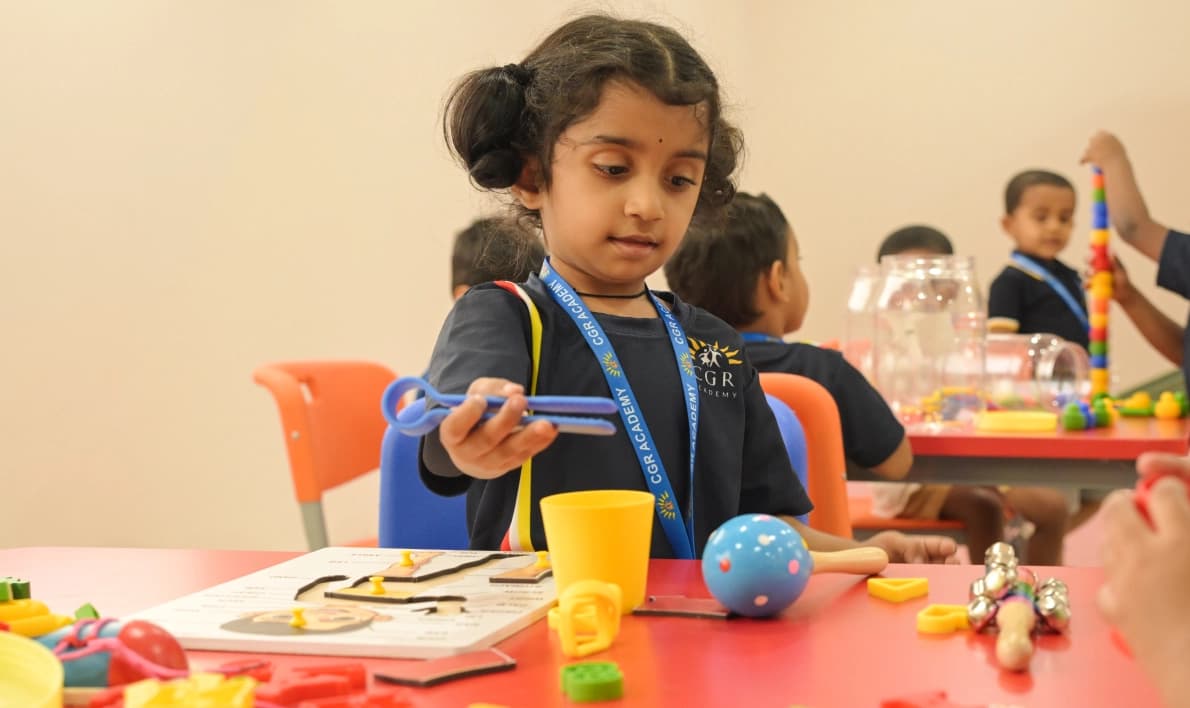
Painting, cutting, arranging objects, dancing, outdoor games and simple hands-on activities help children use their bodies while making sense of ideas. Pretend play adds another layer. A cardboard box can become a bus. A corner of the classroom can become a shop. Suddenly, language, imagination and social skills are all part of the same activity.
For parents comparing the best pre primary schools in Hyderabad, this is worth noticing. The question is not only what children are taught, but what they are actually allowed to do while learning.
When Play Starts Looking Like Learning
Sometimes the most useful learning moments are the ones that do not look very serious. A child pretending to run a shop is learning to use words, count objects, remember what comes next and interact with another child. A puzzle can teach patience. Building with blocks can teach balance, size and simple problem-solving. Even a messy art activity asks a child to make choices and use their hands carefully. At three, these small experiences matter because children are still building their understanding of everyday things. This is why a pre-primary classroom should not feel like a smaller version of a primary classroom. There should be space to move, talk, imagine, make mistakes and try again. When activities are planned thoughtfully, play gives children a natural way to look at ideas without feeling that they are being tested every few minutes.
What About Letters, Numbers And Academics?
This is often where parents become unsure. If a child is spending so much time playing, when does the “real” academic learning happen?
The answer is that early academic foundations can grow through play too. Counting objects, recognising patterns, listening to stories, drawing shapes, talking about pictures and sorting things all prepare children for later reading, writing and mathematics.
So, is play-based learning better than academics in preschool? It may be more useful to see the two as connected rather than competing. A three-year-old does not need to choose between learning and play. Good early learning can make room for both.
A School Environment That Lets Children Learn
At CGR Academy, we believe young children learn better when they have room to learn, ask questions and take part in activities rather than simply sit and listen. Our approach grows from 15 years of experience at CGR International School and combines Cambridge-inspired teaching practices with the CBSE framework.
Even at the early stages, the aim is to encourage children to wonder about things and ask “why” and “how”. The seven-acre campus, including four acres of outdoor play and learning space, also gives children room to move, play and experience learning beyond four walls.
Play Can Build The Skills That Come Later
Something as simple as building a block tower can quietly involve patience, coordination, decision-making and problem-solving. A group game can involve communication and teamwork. Drawing can involve concentration and fine motor control.
These skills may not appear on a worksheet, but they become useful later when children have to write, solve problems, work with classmates or explain an idea.
This is also something parents looking at pre primary schools in Kollur or nursery schools near Velimela may want to think about. A good preschool experience is not only about how quickly a child learns letters or numbers. It is also about whether the child is becoming comfortable with learning itself.
What A Three-Year-Old Really Takes Home
At the end of a day, a three-year-old may not come home and explain what was learned. There may only be a messy drawing, a story about a toy, or an excited description of something that happened outside.
But underneath those small moments, the child may have learned to wait for a turn, try again after something failed, notice a pattern, use a new word, ask a question or imagine something that was not there before.
That is the quiet value of learning through play. At three, children do not need every experience to look like a lesson. Sometimes the block tower, the pretend shop, the muddy hands and the endless “why?” are the lessons.
FAQs:
1. What is learning through play in pre-primary education?
Learning through play is an approach where young children develop knowledge and skills through activities such as building blocks, storytelling, painting, puzzles, pretend play and outdoor games.
2. Why is play-based learning important for 3-year-old children?
Play-based learning helps three-year-olds develop creativity, communication, problem-solving, coordination and social skills while exploring their surroundings in a natural way.
3. What are some examples of play-based learning activities for 3-year-olds?
Popular activities include building blocks, colour sorting, storytelling, pretend cooking, painting, puzzles, sand play, water activities, music and movement games.
4. How does play-based learning improve social skills in young children?
Group activities teach children to share toys, take turns, communicate their needs, listen to others, cooperate and understand different perspectives.
5. How does activity-based learning support early childhood development?
Activity-based learning encourages children to explore concepts through hands-on experiences. It supports cognitive, physical, emotional, language and social development.