
How Schools Can Prepare Children for the AI-Driven Future
Artificial intelligence is already changing how children learn, work and find information. That does not mean schools need to turn every child into a programmer. In fact, that may miss the bigger point.
The future will need children who can use technology without depending on it for every answer. They will need to ask questions, think clearly, solve problems and work well with other people. So, preparing children for an AI-driven future is less about teaching one new subject and more about changing how learning happens.
Teach Children How to Think, Not Just What to Remember
When information is available within seconds, memorising everything becomes less important than knowing what to do with that information.
Schools can give children more opportunities to question answers, compare ideas and explain why they think something is right or wrong. This is where AI education in schools can be useful when it goes beyond simply showing children how an AI tool works.
At CGR Academy, learning is built around encouraging students to ask “why” and “how”, rather than simply accepting information. Its blended approach brings together elements of Cambridge teaching with the structure of CBSE learning, while keeping curiosity and critical thinking in the picture.
Make STEM Learning More Practical
Science, technology, engineering and mathematics will remain important, but children often understand these subjects better when they can actually use them.
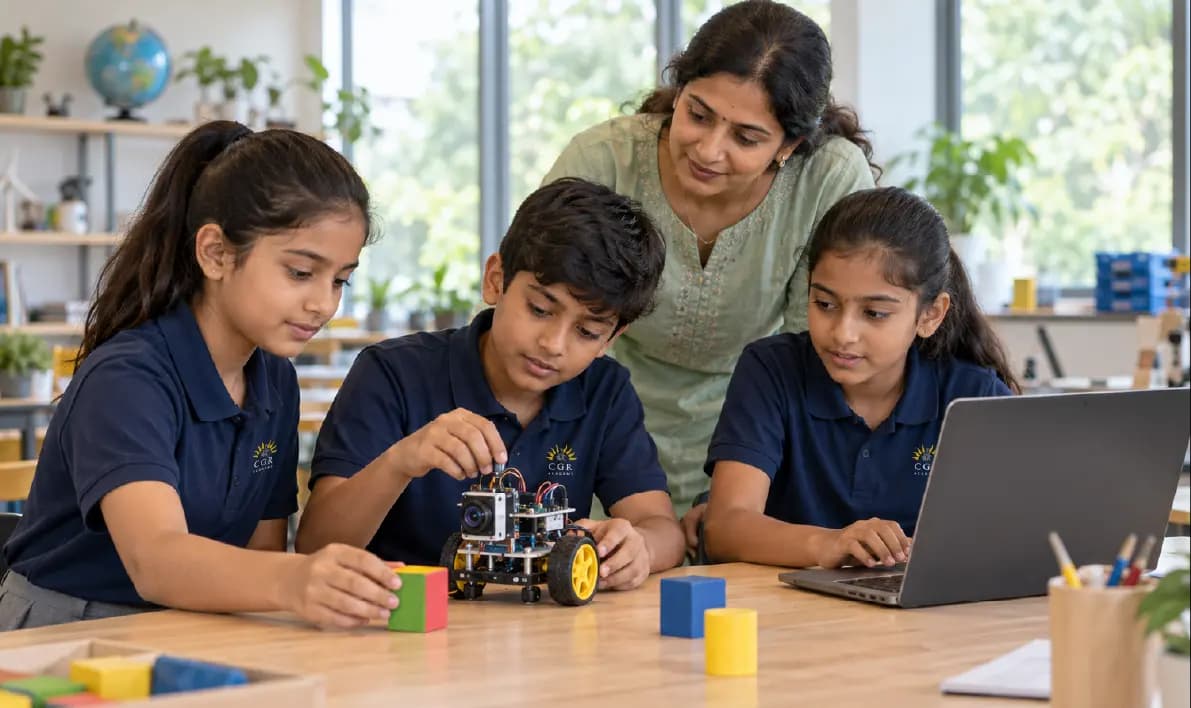
This is why STEM learning in schools should not feel like another chapter to finish before an exam. Simple experiments, building activities, design challenges, coding tasks and technology-based projects can make these subjects feel connected to real life.
The idea is not to make every child interested in engineering. It is to help children become comfortable with trying something, getting it wrong, changing the approach and trying again.
CGR Academy supports this kind of learning through spaces such as its STEAM Lab and Design Thinking Lab, where students can look at ideas through hands-on activities and problem-solving.
Give Children Experience With Technology
Children are already comfortable using phones, tablets and computers, but using technology casually is different from understanding it.
Schools can teach students how digital tools work, how to check information and where technology can be helpful or misleading. They can also introduce age-appropriate AI tools while discussing originality, privacy and responsible use.
Tech-enabled classrooms, ICT spaces and learning resource centres can make this easier because technology becomes part of everyday learning instead of something introduced only during a special class.
This is one reason parents comparing the best schools for AI and future skills in Hyderabad may want to look beyond whether a school simply mentions AI on its website. The more useful question is how technology is actually used inside classrooms.
Build Creativity Alongside Technology
There is a slightly strange idea that technology will make creativity less important. It may actually make the opposite true.
When machines can produce text, images and other content quickly, children still need to decide what is worth creating. They need imagination, taste, communication and the ability to bring an original thought to something.
Music, art, dance, theatre and creative projects can therefore have a real place in future-focused education. They are not distractions from technology. They help children develop a different way of thinking.
For parents looking for the best international schools in Hyderabad, this balance can be worth noticing. A future-ready school should have room for both digital learning and activities that have nothing to do with a screen.
Develop Social And Emotional Skills
AI may become better at many tasks, but children will still grow up, make friends, disagree with people, lead teams and deal with difficult situations.
That makes communication, empathy, cooperation and emotional awareness important parts of education. These skills cannot simply be downloaded into a child through an app.
Schools can build them through group activities, sports, clubs, classroom discussions and situations where children have to listen to different opinions.
CGR Academy also places attention on EQ alongside IQ, with co-curricular activities, sports and social-emotional learning spaces designed to give children opportunities to grow beyond academics.
Give Children Spaces To Learn
A future that keeps changing can be difficult to prepare for through a fixed set of lessons. Children need some freedom to understand interests and discover what they enjoy.
A school with science labs, creative spaces, technology areas, sports facilities and clubs can offer different ways to learn. It also gives children a chance to discover strengths that may not appear during regular classroom work.
This is something families considering the best schools in Kokapet or schools in Kollur Hyderabad may want to think about when comparing campuses. The physical learning environment can quietly influence how much children experiment, move around and try new things.
Choose A Curriculum That Leaves Room For Change
A strong academic foundation still matters. Reading, mathematics, science and other core subjects are not going away just because AI is becoming more common.
What may need to change is how those subjects are taught. A child should be able to learn the basics while also connecting them with creativity, technology, communication and problem-solving.
This is also useful for families looking at the best CBSE schools in Hyderabad. The curriculum matters, but so does what happens around it. A good school should leave enough space for children to learn beyond the textbook.
Why CGR Academy Takes A Balanced Approach
At CGR Academy, we focus on preparing children for a changing world without losing sight of the basics. We bring together elements of Cambridge teaching with the comprehensive CBSE framework, helping students build strong subject foundations while developing curiosity, creativity and critical thinking.
Our 7-acre campus includes tech-enabled classrooms, an ICT Lab, Design Thinking Lab, Imaginarium- STEAM Lab, SEL Lab and creative spaces for music, art and dance. We also provide sports and co-curricular opportunities that support learning beyond academics. We believe children need both IQ and EQ to move confidently into the future. The aim is simple: to give students space to learn, question, create and gradually understand where their abilities can take them.
Final Words
Preparing children for an AI-driven future does not mean filling their timetable with technology.
It means helping them become comfortable with change while giving them strong foundations to stand on. They should know how to use technology, but also when not to use it. They should be able to find information, but also question it. And they should have the confidence to create, communicate and work with others.
That is probably the more sensible way to think about future-ready education. AI will keep changing. The tools children use today may look completely different a few years from now. The ability to think, learn and adapt, however, is likely to stay useful for a very long time.