
The Role of Critical Thinking in Preparing Students for the Future
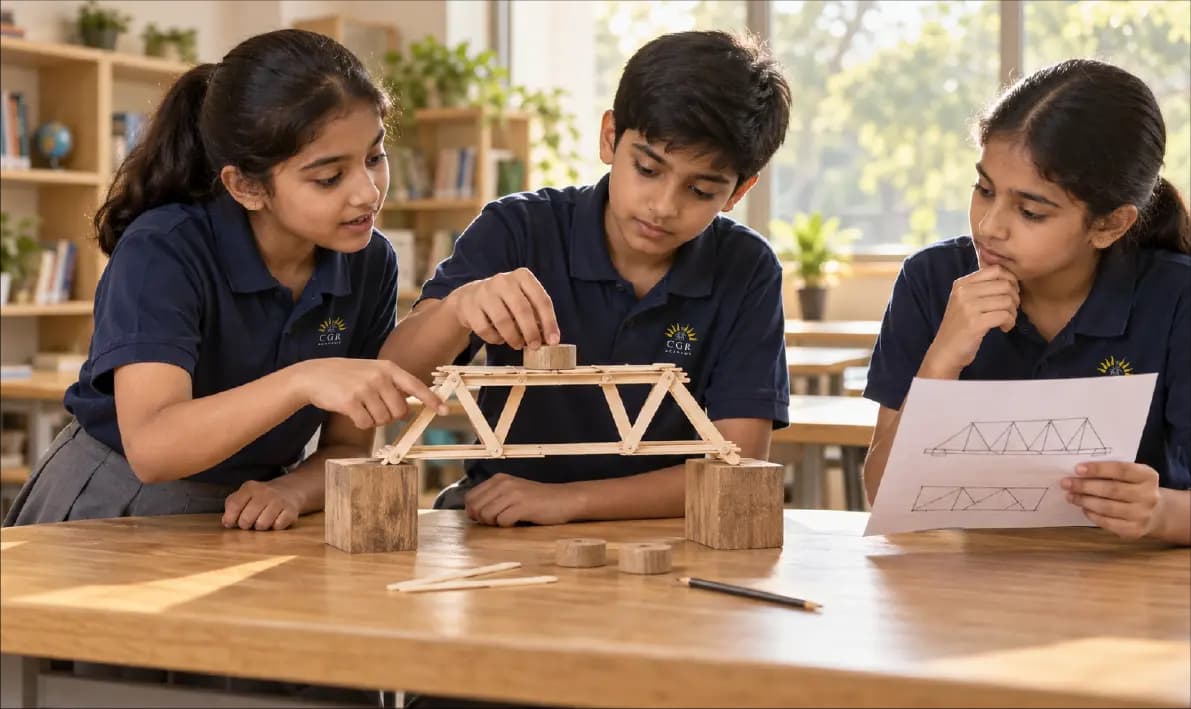
There is something interesting about the way children ask questions. A young child can ask "why?" five times about the same thing without getting tired. Somewhere along the way, that habit often becomes quieter. School becomes about finding the right answer instead of wondering if there is another one.
That is probably why conversations around critical thinking in education matter so much today. The future does not seem like a place where memorising facts will be enough. New ideas, new technology, and new challenges keep showing up. What stays useful is the ability to pause, think, question, and make sense of things before reacting.
Maybe that is what learning should really leave behind.
Thinking Beyond The Right Answer
There is a difference between knowing something and understanding it. A student may remember a formula perfectly but still struggle to use it in a new situation. That happens more often than people realise.
Critical thinking is not about arguing or finding faults in everything. It is about looking at a situation carefully and asking simple questions. Does this make sense? Is there another way to solve it? What happens if something changes?
These small habits slowly build critical thinking skills for students. They help children become less afraid of unfamiliar problems because they learn that not every question has just one path.
Why The Future Needs Curious Minds
The jobs children will have tomorrow may not even exist today. That thought sounds surprising at first, but it also changes how education is viewed.
A future filled with change needs people who can learn again and again. That is where future-ready education becomes important. Instead of teaching students only what to remember, it helps them understand how to learn, adapt, and think independently.
The world keeps changing its tools. Thinking stays useful even when the tools change.
Small Classroom Moments Matter More Than They Seem
Critical thinking does not always begin with a big debate or a difficult project. Sometimes it begins with a teacher asking, "What do you think?" and actually waiting for an answer.
Students learn differently when they are allowed to explain their ideas, even if those ideas are incomplete. They learn that making mistakes is part of understanding something better.
Simple discussions, science experiments, storytelling, puzzles, and group conversations become critical thinking activities for students because they encourage children to observe and connect ideas instead of repeating information.
Those moments often stay with students longer than the lesson itself.
Learning To Solve Real Problems
Life rarely gives problems exactly the way textbooks do. Things are usually a little messy, with missing information and more than one possible answer.
That is why schools need to help children practise problem-solving skills for students in everyday learning. It could be solving a maths question in different ways, planning a class activity together, or figuring out why an experiment did not work.
These experiences teach patience as much as answers. Students begin to understand that solving a problem is often about thinking through it step by step rather than rushing to finish first.
The same habit grows into stronger problem solving skills for students as they face bigger challenges later in life.
Where CGR Academy Builds This Way Of Learning
At CGR Academy, learning is built around questions, not just answers. We build on 15 years of trusted excellence from CGR International School through a blended curriculum that brings together Cambridge-inspired teaching methods and the CBSE framework.
We encourage students to ask "why" and "how" while building strong foundations in academics, creativity, and global awareness. It is a way of learning that supports curiosity instead of asking children to simply memorise information.
Learning That Feels Connected To Real Life
A child usually remembers something better when it feels connected to everyday life. Reading about plants is one thing. Growing one is another. Learning about science becomes different when students can test an idea with their own hands.
At CGR Academy, we try to create these connections through technology, projects, hands-on learning, and classroom experiences that make concepts easier to understand. Lessons become more practical, and students get opportunities to think through ideas instead of only reading about them.
That is how critical thinking in education slowly becomes part of everyday learning rather than a separate subject.
Growing Skills Inside And Outside The Classroom
Learning does not stop when a class ends. Sports, art, music, clubs, and creative activities often teach lessons that cannot be written on a worksheet.
A student playing on a team learns communication without noticing it. A child working on an art project learns patience and decision-making. A science lab encourages observation. A debate teaches listening before speaking.
At CGR Academy, students have spaces to look at different interests across a spacious 7-acre campus with outdoor learning areas, science and design thinking labs, sports facilities, music studios, art rooms, and technology-integrated classrooms.
These experiences quietly develop many of the skills students need for the future because children learn to think, work together, and adapt in different situations.
Preparing For A Future That Keeps Changing
No one really knows what the future classroom, workplace, or world will look like twenty years from now. That uncertainty can feel uncomfortable, but it also reminds us what education should focus on.
Children need knowledge, of course. They also need curiosity, confidence to ask questions, and the ability to think through unfamiliar situations without giving up too quickly.
That is what future-ready education is really trying to build. It prepares students to keep learning long after school is over, and that feels like a much stronger foundation than simply knowing the correct answer today.
Verdict
Critical thinking is not a skill that appears overnight. It grows through everyday conversations, thoughtful questions, mistakes, experiments, and moments of curiosity. Schools play a big role in protecting that natural curiosity instead of replacing it with memorisation alone.
When students learn how to think, question, and solve problems with confidence, they are not just preparing for exams. They are preparing for a future that will keep changing, and they will have something steady to carry into it: the ability to understand, adapt, and keep learning.